
Protecting Those Who Protect Us
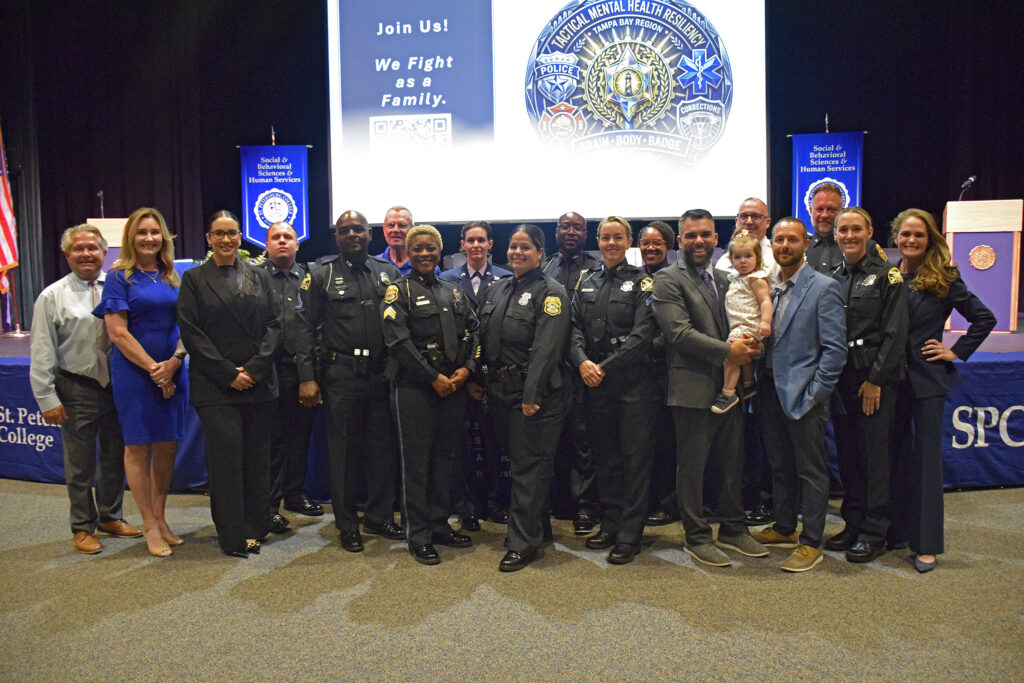
Officers Graduate from Groundbreaking Mental Health Program
New Class of Mental Health Liaisons Brings Critical Support Back to Tampa Bay Law Enforcement Agencies
First responders are trained to run toward crisis, but the emotional toll of that work often builds quietly over time.
Throughout their careers, law enforcement officers may respond to violent crime scenes, fatal crashes, child abuse investigations, and active threat situations. Research shows that one in three law enforcement officers experience symptoms of post-traumatic stress, compared to just 6% of the general population, while suicides among officers continue to outpace line-of-duty deaths.
To help address this growing concern, a groundbreaking program in Tampa Bay is giving officers practical tools to better protect themselves and one another.
Earlier this month, law enforcement officers from agencies across the region graduated as the third class of the Applied Mental Health Advanced Technical Certificate for First Responders program at St. Petersburg College (SPC). Developed in partnership with the Suncoast Police Benevolent Association, the program prepares law enforcement professionals to serve as mental health liaisons within their agencies and strengthen peer support systems.
The accredited nine-month certificate program is offered at no cost to first responders thanks to continued support from the Pepin Family Foundation and Tampa Bay Area Chiefs of Police Foundation.
This year’s graduating class included 14 officers and professionals from the St. Petersburg Police Department, Tampa Police Department, Hillsborough County Sheriff’s Office, Clearwater Police Department, Pinellas Park Police Department, and Bradenton Police Department. Each graduate brings back new tools, deeper awareness, and a shared commitment to ensuring no first responder faces mental health challenges alone.
For Sgt. Corey Lenczden of the Clearwater Police Department, a 25-year veteran who spent much of his career investigating sensitive sex crime cases, the program challenged long-held beliefs about how officers manage trauma and stress. His perspective is also shaped by the loss of a close friend and fellow officer to suicide.
“We were taught to compartmentalize everything we saw. Over time, you realize that’s not a long-term solution,” said Sgt. Lenczden. “There are so many resources and techniques out there that I didn’t know about before. It’s given me a better understanding of how to process what we experience in healthier ways—and how to help others do the same.”
For Sgt. Lenshawn Price, who has served with the Clearwater Police Department for 26 years, the lessons learned reached beyond the workplace.
“I took this class because I needed better tools—not just for the job, but for life,” Price said. “What I’ve learned has already changed how I show up for my family and for the officers I supervise.”
The impact of the program also resonated with Carlos Brito, a digital forensic analyst with the Hillsborough County Sheriff’s Office. After being intentionally struck by a vehicle in the line of duty two years ago, Brito endured 17 surgeries that tested him physically and emotionally. His experience deepened his commitment to mental health awareness and advocacy.
“We’re so quick to jump in and help others, but when it comes to helping ourselves and first responders, we pause. I hope we don’t pause. We need to take action and help ourselves,” Brito said.
The first-of-its-kind certificate program was developed by Sun Coast Police Benevolent Association President Jonathan Vazquez and Executive Director and General Counsel Sasha Lohn, Esq., drawing from their firsthand experiences supporting officers facing mental health challenges.
“This program is helping reshape the culture within law enforcement,” said Jonathan Vazquez, President of the Sun Coast Police Benevolent Association. “For too long, first responders have carried what they experience without the tools to process it. That has to change, and this program is helping lead that change.”
“This effort is about more than education—it’s about real access to support,” said Sasha Lohn, Executive Director and General Counsel of the Sun Coast Police Benevolent Association. “We’re making sure officers have the resources and training they need now, not only when they’re already in crisis.”
With legislative support from State Rep. Linda Chaney and Sen. Ed Hooper, SPC developed and implemented the accredited program to expand mental health education and peer support resources for first responders.
For the Pepin Family Foundation, supporting this work reflects its broader commitment to mental health and wellness for frontline professionals.
“Officers are trained to handle high-stress situations, but they’re not always given the same support to process what they’ve experienced afterward,” said Tina Pepin, Executive Director of the Pepin Family Foundation. “When we invest in their mental health, we strengthen families, agencies, and the communities they serve.”
The long-term impact of the program extends beyond individual graduates and into the departments and communities they serve.
“Each graduate brings these skills back into their agency, which helps strengthen the entire profession,” said Greg Mertz, President of the Tampa Bay Area Chiefs of Police Foundation. “They’re building stronger peer support systems and more resilient teams on the front lines.”
The graduation ceremony, held at SPC’s Clearwater Campus, featured keynote speaker John Violanti, a nationally recognized expert on police stress, trauma, and suicide.
As part of the program, each class completes a capstone project. This year’s cohort will continue its work by hosting a two-day training on August 27–28 for first responders. The training will condense key lessons from the certificate program into a practical course focused on resilience, recognizing warning signs, and developing healthier coping strategies to support long-term career sustainability.
By equipping officers with these tools and building stronger support systems from within, the program is helping create a culture where seeking help is viewed not as weakness, but as strength—and where those who protect our communities receive the support they deserve in return.